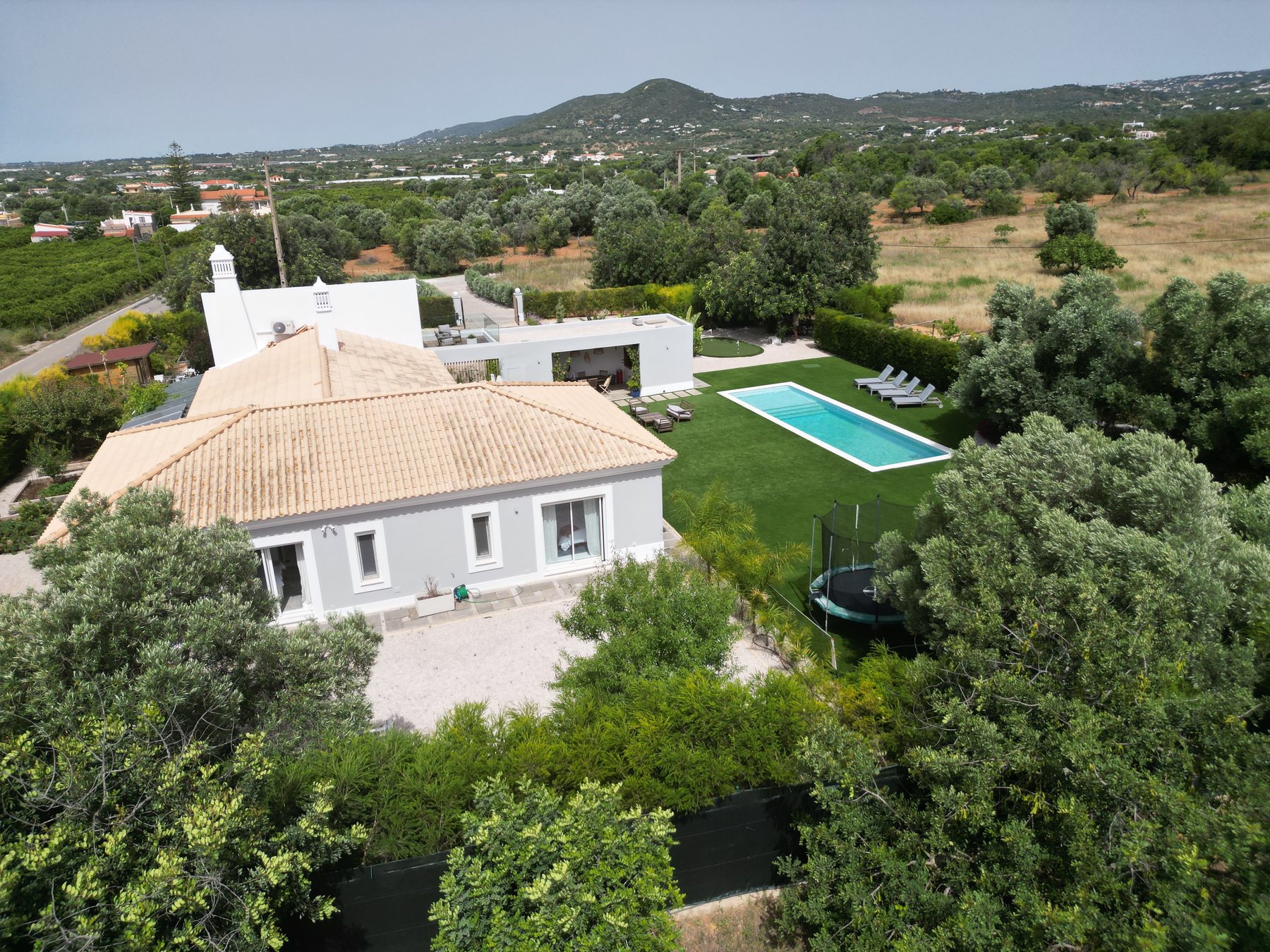
The first thing I always say about Vale da Rosa is that it was built to be lived in, not thrown up to flip — and it shows in the construction and the finish. It is a single-storey four-bedroom house on two hectares of olive, fig and carob, ten minutes inland of Faro, built in 2022 and engineered to energy class A. What follows is the honest read I owe a buyer before we walk the land: what is here, how it is built, and the one or two things worth factoring in.
I have walked the land with him three times. Once before it was on the market, when he was still deciding what to ask. Once with the engineer who signed off the energy certificate. And once with the man who installed the borehole pump. I asked the engineer to tell me, off the record, what corners had been cut. There was a long pause and he said: «None that I can see.»
What it actually is.
Four bedrooms. The master with its own dressing room and bathroom, separated from the others by the entrance hall. A second suite with its own bathroom. A single bedroom with a dressing room. A double bedroom. They share a fourth bathroom. There is also a small guest WC by the entrance for visitors who never need to go further in.
The whole thing is on one floor — single-storey, ground level — except for a studio above the garage, which sits separately and was finished after the rest. It has its own bathroom, its own external entrance via a metal staircase, and its own air-conditioning unit. It works as a studio, a home office or a self-contained guest flat — whatever the next owner needs.
The living-dining room is sixty square metres in a single open volume, with one wall of 33.1 mm laminated safety glass that opens onto the garden and the pool. The kitchen runs along the back, fully fitted, with a BORA induction hob, a SMEG fan oven, a QUOOKER tap with boiling and sparkling water, a LIEBHERR wine cooler, and a KitchenAid integrated dishwasher. Everything you can see in the photographs comes with the house.
Why Estoi.
Estoi is the village ten minutes east of Faro that the rest of the Algarve hasn't quite noticed yet. It has a Saturday market that has been running since the seventeenth century, a baroque palace converted into a Pousada, and a Roman ruin (Milreu) you can walk to in twenty minutes. The town has just over a thousand inhabitants. It has not been resort-ised.
The villa sits on the CM 1309 — the small municipal road that runs out of the village towards the agricultural land at the foot of the foothills. From the house you can see olive groves, citrus orchards, a couple of greenhouses, and one cypress-lined drive in the middle distance. You cannot see another building. You cannot hear traffic. At night the only light is from the moon and, faintly, Faro on the horizon.
This matters because the rest of inland Algarve has been quietly bought up over the last five years. Estoi has not. The land prices around the village have risen from roughly €40/m² in 2020 to €92–€140/m² in 2026, which is up but a fraction of what's happened in São Brás or Tavira's hinterland. If you are buying for the medium term, the inland-of-Faro band is now where Loulé was four years ago.
The land.
Two hectares is 20,200 m² — 145 metres by 140 metres, more or less. The plot is gently terraced. From the road edge the land rises 6.7 metres to its highest corner; the house sits about two-thirds of the way up, on the long axis. You walk it in about twelve minutes if you do all four sides.
The trees are what the Algarve had before it had villas. Olive throughout — a few of them probably a hundred years old, the rest planted long before the house went up. Almond and fig in the lower terraces. Two carob and one mature holm oak. A row of cypresses bordering the inner garden line. Dry-stone boundary walls (muros de pedra solta) on three sides, masonry on the road frontage.
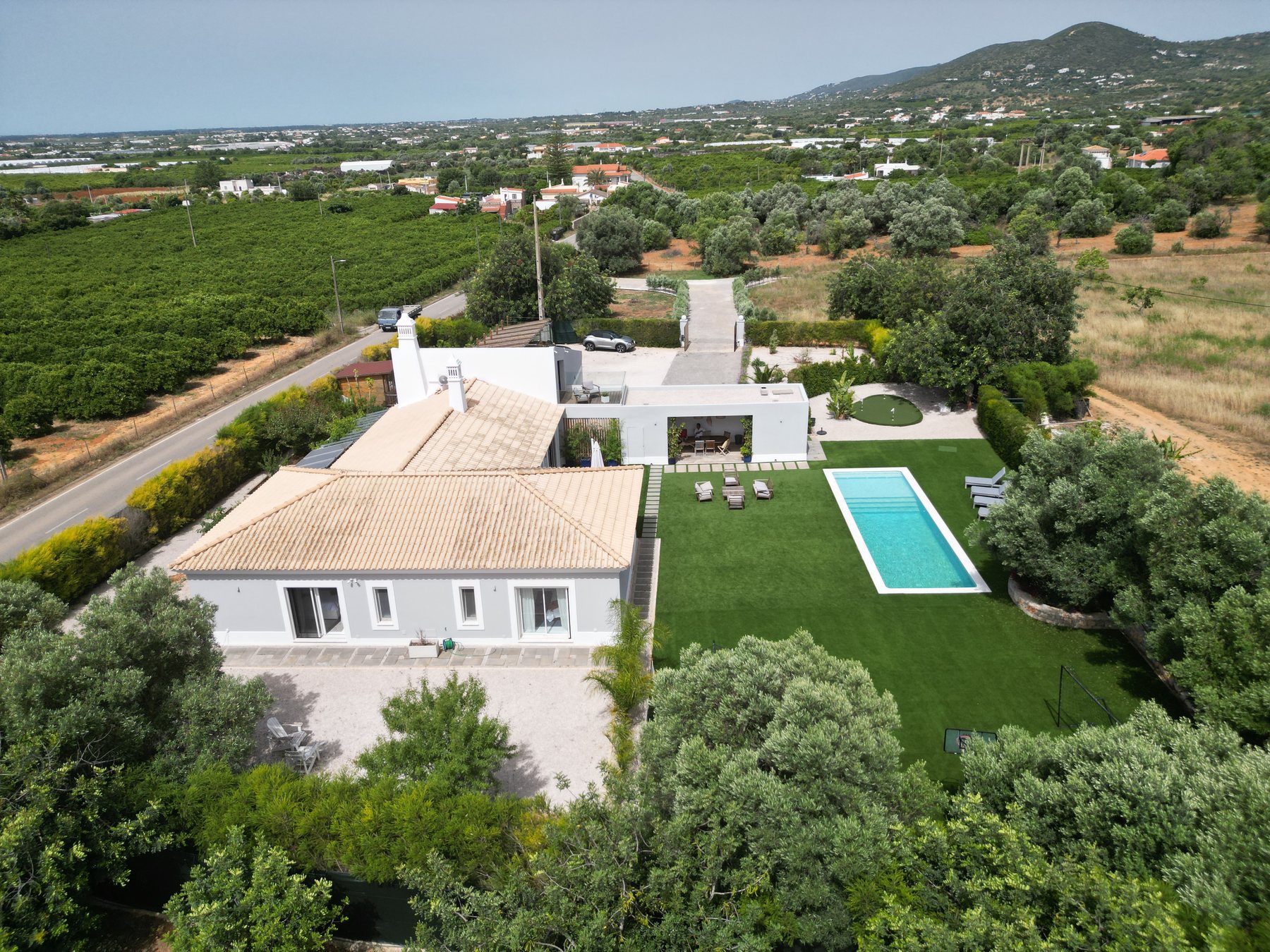
The borehole is at the south-west corner, the water tank is mid-plot, and the irrigation system is laid through the olive groves on a timer. Grey water is separated and treated through an ALMAQUA 2000 L compact plant — fitted not because the law required it but because it makes the whole system more resilient. The septic tank for black water is buried at the north-east corner with an evapotranspiration trench beyond it.
The math, in public.
€92 per square metre of land. €7,400 per square metre of built area. €370,000 per bedroom. These are the three numbers I bring to every viewing, before anything else.
37°8 Property IntelligenceI think prices ought to be worked out in public. The whole industry hides them behind adjectives because the adjectives sell better than the numbers do. I want the buyers we work with to leave a viewing knowing what the three or four cleanest comparable transactions in the area sold for, and how this one stacks up.
For Vale da Rosa, the cleanest comparable on built area I can find is a 280 m² four-bedroom new-build in São Brás de Alportel that sold in February for €1.9m. That puts that one at €6,786/m². Vale da Rosa is asking €7,400 — about 9% higher per built m² — but sits on six times more land. That difference is the trade-off the buyer is making. I think it's a fair trade, but I would, because I'm the agent selling it.
What I don't love.
Two things. First: there is no photovoltaic. The roof has 90 m² of unobstructed south-facing surface, perfect for it, and it was costed during the build but deferred — the thinking at the time was that a system specified then would be outdated within a few years. I think that was the wrong call to leave for a buyer. Adding a 9-kilowatt array with a battery and a hybrid inverter today would cost a buyer €18,000 to €24,000 and would change the energy class from A to A+ once recertified — and would mean the house is genuinely close to off-grid in the summer months.
Second: the studio above the garage and the pool/BBQ area were built but were not included in the 2022 use licence. They were finished after the licence was issued, which is technically a thing that happens often in the Algarve and is rarely an issue, but it does mean the next owner will inherit the regularization paperwork. The cost to put it through is €4,000 to €6,000. I think it should be done before resale, not after.
Everything else on the file is clean. The full set of measurements, floor plans and the legal position are laid out on the property page. Open the file and you can read the same detail I'm reading — the underlying certificates and registry documents are shared privately with serious buyers.
The numbers in short
| Total plot | 20,200 m² |
| Built area | 250 m² |
| Bedrooms | 4 + studio |
| Bathrooms | 4 |
| Year built | 2022 |
| Energy class | A |
| Use licence | In place |
| Asking | €1,850,000 |
Who it's for.
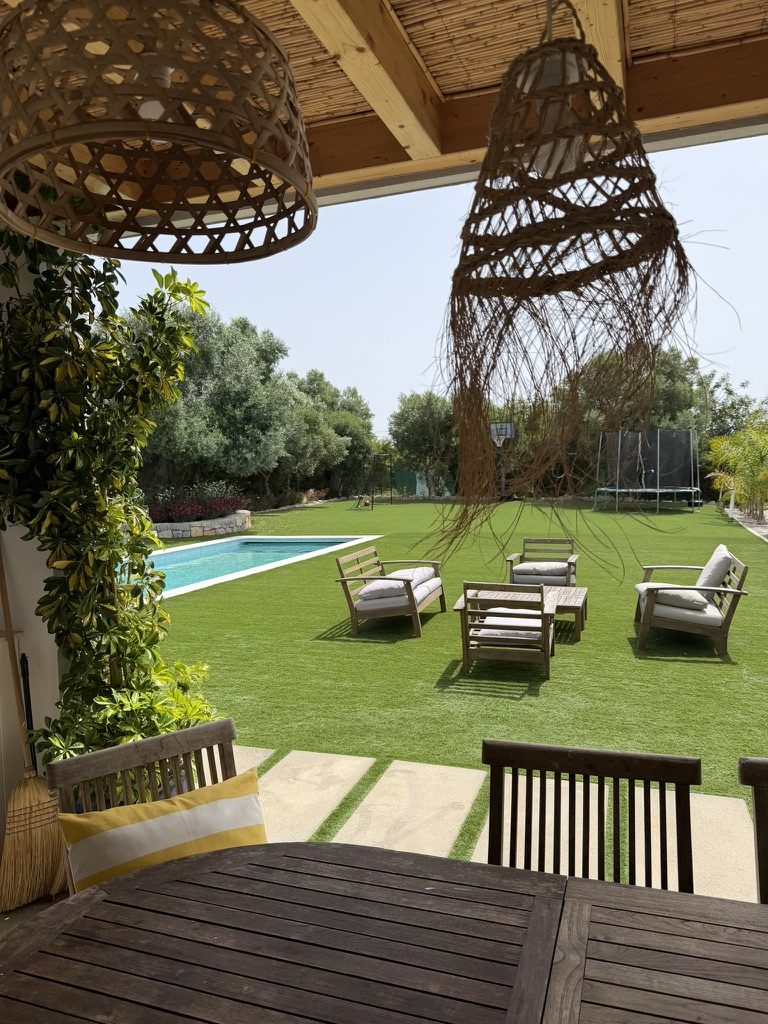
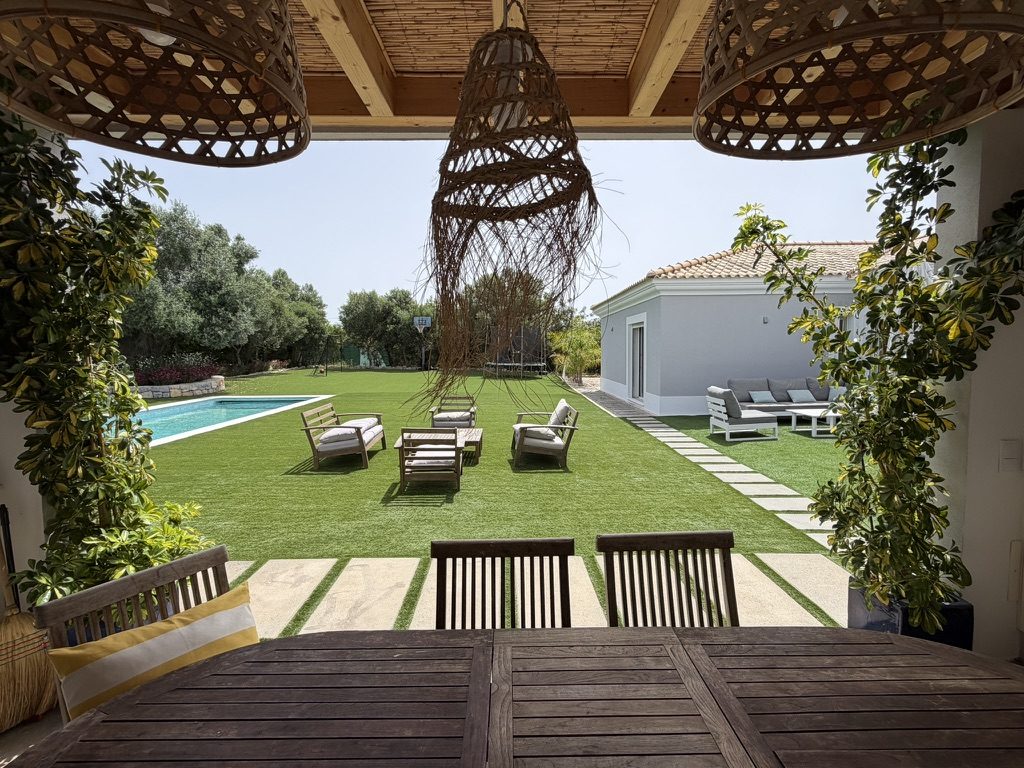
Two answers. It works comfortably for a family of five or more. Four bedrooms downstairs, a sixty-square-metre living room that absorbs noise, a 13-metre pool with a one-metre beach shelf at the shallow end, an outdoor kitchen, a garage with a table-tennis table, a putting green and a trampoline. The garden is big enough that the children can be lost in it.
The second answer is the one that's been less obvious to people who first see the file. With the children gone — and I say this as someone whose oldest left for university two years ago — the house quietly closes up. Three of the four bedrooms become guest rooms. The studio above the garage runs as a writing room or a yoga studio. The pool cover takes the work out. The energy bill stays small. The borehole stays your own. The two hectares of olive give you enough work and walk to fill an unstructured Algarve day.
I have shown this house to four families and to two couples in their early sixties. They all paused at the same spot — by the live-edge window of the master bedroom, looking south through the olive grove. The couples paused longer.
See the full file.
Six measurements, four floor plans, the appliance brands, the elevation survey. Laid out in full.